- AI can create good websites. But can they stand out?
- Anyone can build a website today
- What makes a website feel premium?
- AI can also help maintain professionally designed websites
- A modern web design workflow with AI and Webflow
- The future of web design is human creativity powered by AI
- Frequently asked questions
- References & sources
Guides
Why Human-Centred Web Design Matters in the AI Era


Contents
More than 15 years ago, when I started working as a web designer, I was designing websites in Photoshop. Over the years, tools like Sketch, Adobe XD and Figma came along and made our work significantly easier. But the fundamental process remained the same. Every design was created manually, and every line of code had to be written. Then I discovered Webflow in 2016. It completely changed the way I worked, allowing me to turn my designs into fully functional, CMS-powered websites much faster without sacrificing creative freedom. For the past decade, this approach has worked incredibly well for me. And it still does.
More than 15 years ago, when I started working as a web designer, I was designing websites in Photoshop. Over the years, tools like Sketch, Adobe XD and Figma came along and made our work significantly easier. But the fundamental process remained the same. Every design was created manually, and every line of code had to be written.
Then I discovered Webflow in 2016. It completely changed the way I worked, allowing me to turn my designs into fully functional, CMS-powered websites much faster without sacrificing creative freedom. For the past decade, this approach has worked incredibly well for me. And it still does.
But with the arrival of artificial intelligence, something fundamentally different is happening in the web design industry. Anyone can now create a visually appealing and functional website within minutes. As exciting as that sounds, I believe we are also witnessing the rise of a new phenomenon: the mass production of average design.
I use AI in my daily work and genuinely appreciate what it brings to the creative process. But after more than 15 years in this industry, I believe that human creativity, experience and the ability to make thoughtful design decisions are becoming more valuable, not less.
Key takeaways
- AI makes website creation more accessible, but simply having a functional website is no longer a strong competitive advantage.
- Research suggests that AI can improve individual creative outputs while reducing their collective diversity.
- In Q1 2026, nearly half (49.9%) of newly published articles in one research sample were estimated to be primarily AI-generated.
- Intentional visual design, distinctive identity and creative interactions help brands stand apart and build credibility.
- Combining a professionally designed Webflow template with an AI assistant through MCP (Model Context Protocol) offers both a creative foundation and an efficient way to manage a website.
Building a website is becoming easier. Building one worth remembering is becoming more important.
AI can create good websites. But can they stand out?
One of the greatest advantages of AI website builders is accessibility. Businesses with limited budgets can establish an online presence without investing thousands in professional design and development.
There is nothing wrong with that. Not every business needs an exceptional website from day one.
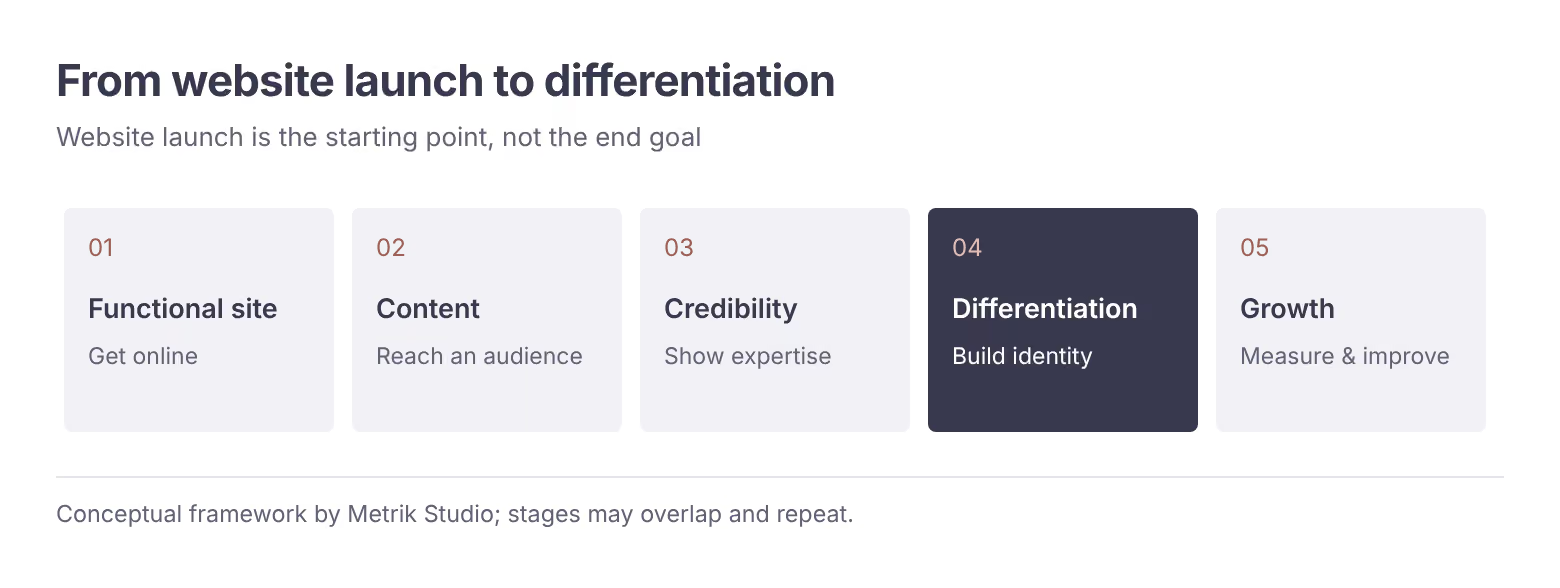
However, launching a website is only the beginning. The real work starts when you need to attract customers, communicate your brand, build credibility, differentiate yourself from competitors and continuously improve your digital presence.
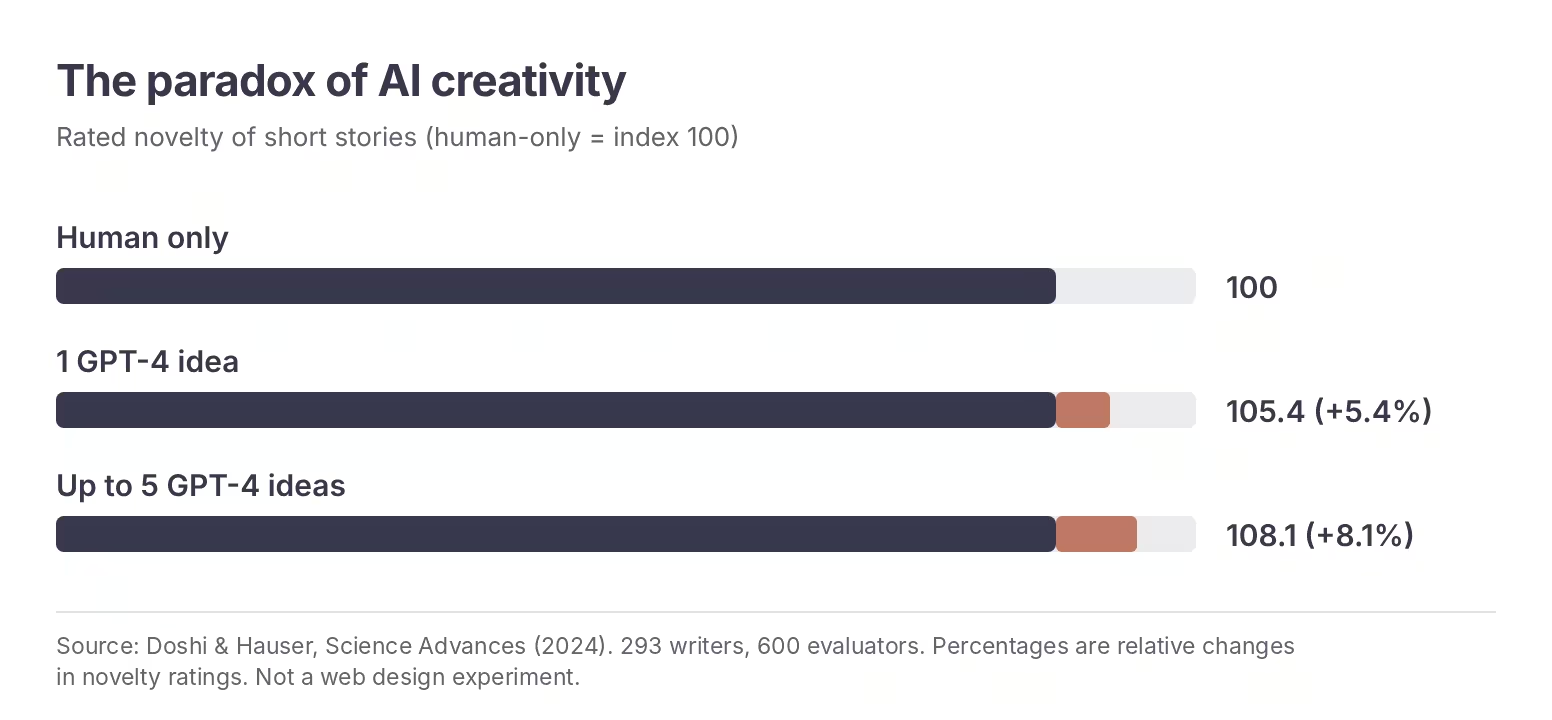
In 2024, researchers Anil R. Doshi and Oliver P. Hauser published a fascinating study in Science Advances examining the relationship between generative AI and human creativity.
In the experiment, 293 writers produced eight-sentence stories, which were assessed by 600 evaluators. Compared with the human-only group, writers given access to one GPT-4 idea received novelty ratings 5.4% higher. Those given access to up to five ideas scored 8.1% higher. The gains were particularly pronounced for less creative writers, but AI-assisted stories also became more similar to one another.
A separate study presented at ACM CHI 2024, led by Samangi Wadinambiarachchi, found a related phenomenon in visual design. Participants using AI-generated imagery during ideation produced fewer ideas, with less variety and originality than the baseline group.
Neither experiment directly measures the quality of AI-generated websites. Nevertheless, both highlight a creative risk that I believe is highly relevant to web design.
AI can improve the quality of individual outputs while potentially reducing the diversity of what we see across the internet.
Imagine 100 business owners who use the same AI tool to create their websites. Each of them might end up with a better website than they could have designed on their own. But if we compare all 100 websites, we may notice similar layouts, typography, compositions and interactions.
AI can improve individual outputs while contributing to greater uniformity across the market. This is precisely why I believe distinctive creative direction and human design judgement are becoming more valuable. This is an illustrative application of the research to web design, not the result of an experiment involving 100 websites.
When everyone has access to the same creative tools, having a good-looking website is no longer enough. Having a distinctive one becomes the real advantage.
Anyone can build a website today
In March 2023, AI expert and author Nina Schick predicted that 90% of online content could be generated by AI by 2025.
A similar estimate appeared in an early Europol report on synthetic content. However, Europol subsequently removed the estimate because of an inaccurate source. The prediction should therefore not be treated as an established fact.
More recent research gives us a clearer picture.
In August 2026, Pew Research Center published an analysis of almost half a million English-language webpages collected over five years.
Its July 2026 findings showed that:
- 10% of sampled webpages displayed significant indications of AI authorship.
- More than one-third of sampled pages published after ChatGPT's release showed indications of AI authorship.
Another study by Graphite, analysing approximately 55,400 English-language articles, estimated that 49.9% of newly published articles in the first quarter of 2026 were predominantly AI-generated.
The same research suggests that this share has remained close to 50% since the first quarter of 2025, rather than continuing the rapid growth observed in earlier years.
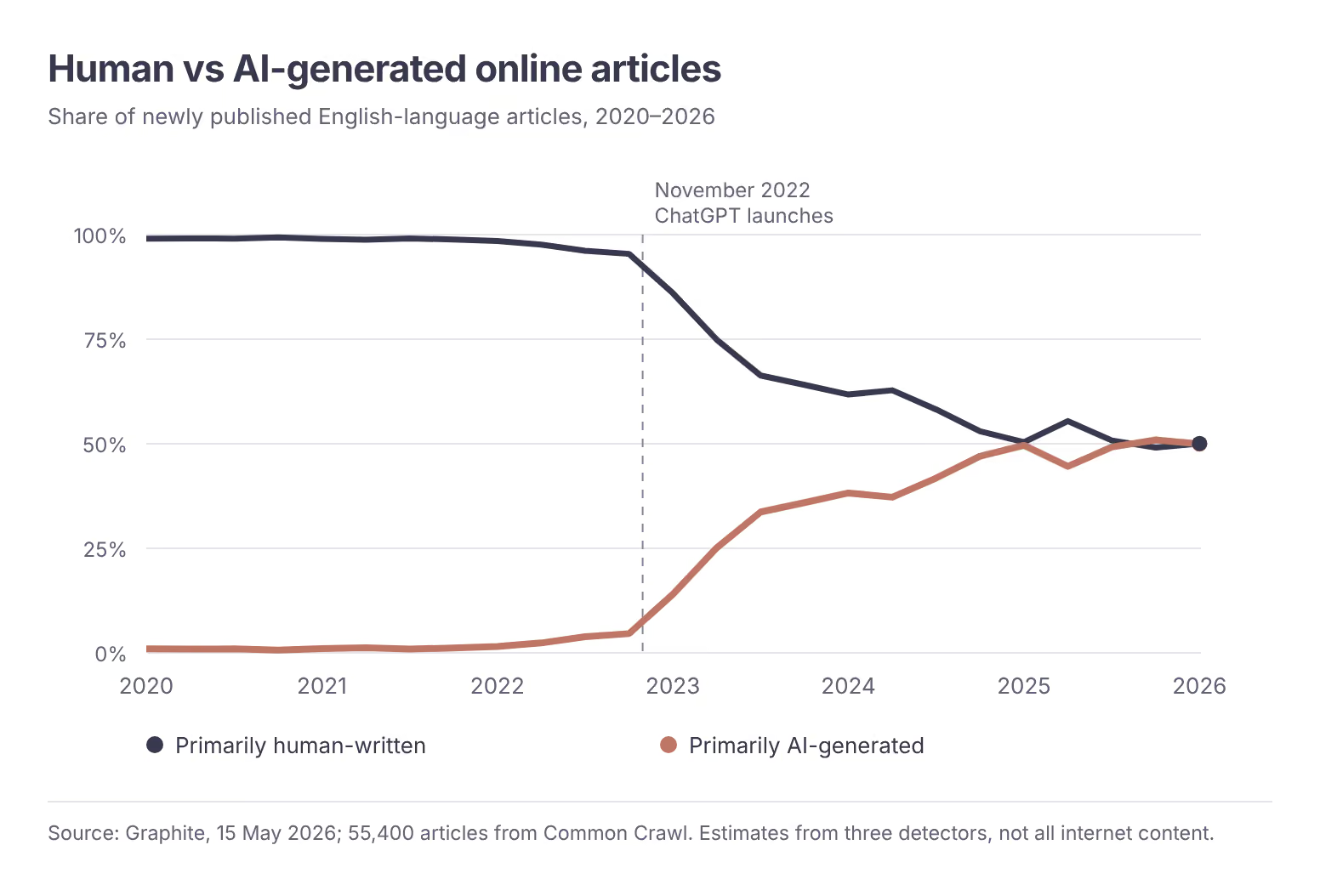
These are estimates based on different samples and detection methods, rather than measurements of the entire internet. But they illustrate how rapidly AI has become part of online publishing.
I believe that in an environment filled with increasingly accessible, automated content, originality and authentic creative direction will become stronger competitive advantages.
The easier it becomes to create something, the more valuable it becomes to create something distinctive.
What makes a website feel premium?
A premium website is not simply a website with attractive typography, large photographs and smooth animations. It is the result of intentional creative decisions that work together.
Human-centred web design is not just about originality or visual appeal. It is about understanding the people who will use the website, anticipating their needs and creating an experience that feels intuitive, accessible and meaningful.
The Stanford Web Credibility Project, led by B.J. Fogg, established long before the generative AI era that visual design, information architecture and usability can significantly influence how people perceive a website's credibility.
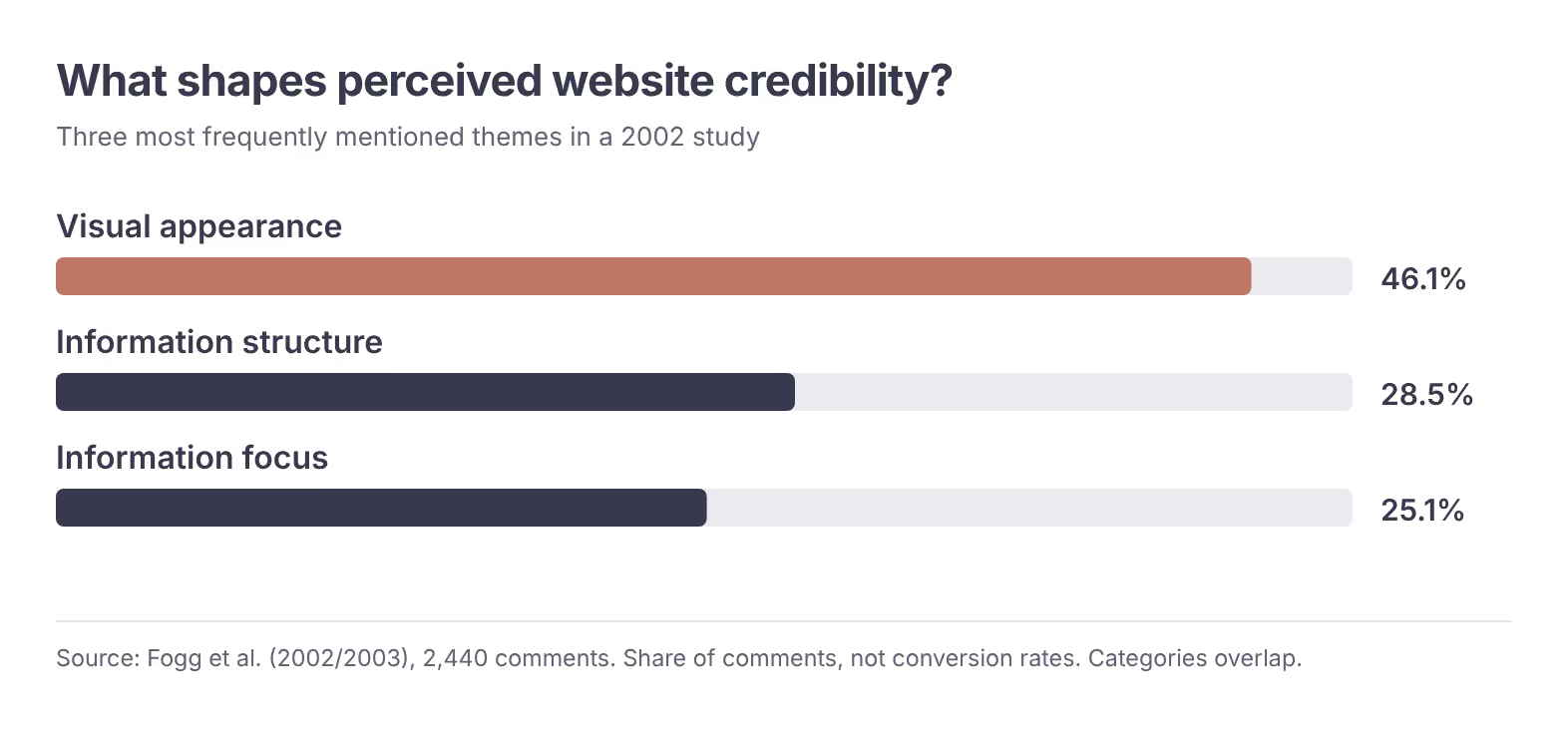
That principle remains relevant today.
A website needs to communicate that there is a real business behind it, with a clear identity, expertise and an understanding of its audience.
This is where I see one of the greatest advantages of professionally designed website templates.
A well-designed template gives you access to an established creative vision, developed through experimentation, experience and attention to detail.
It can provide:
- Distinctive layouts and visual compositions
- Thoughtful typography and art direction
- Creative interactions and motion design
- Consistent visual language across multiple pages
- Content-rich CMS structures designed for real businesses
- A professional foundation for future development
At Metrik Studio, my goal is to create Webflow templates that don't look like templates.
I want each design to have its own character. From the initial layout to the smallest interactive details, the website should feel intentional rather than assembled from predictable design patterns.
The value of a premium template is no longer simply that it saves time. It gives you a creative head start.
Instead of beginning with a generic layout and spending time trying to make it distinctive, you can start with a professionally designed website and use AI to make it your own.
AI can also help maintain professionally designed websites
One argument I frequently encounter is that AI-generated websites are easier to maintain. You simply describe what you want to change, and AI makes the changes for you.
That is a genuine advantage. But it is not exclusive to AI website builders.
With Webflow MCP, you can connect an existing Webflow project directly to an AI assistant, enabling it to work with website content, structure and design within the available permissions. Personally, I use ChatGPT connected to Webflow.
Depending on the available capabilities and permissions, I can ask AI to:
- Rewrite website content across multiple pages
- Create and update CMS content
- Optimise SEO metadata and structured data
- Modify layouts, components and styles
- Review website settings and identify inconsistencies
- Help analyse website performance
All of this can happen through a conversational interface, without rebuilding the website or abandoning its existing design system.
Some tasks still require manual work, visual review and professional judgement. But the ability to manage a website through natural language is no longer a reason to choose an AI-generated website over a professionally designed one.
You can have both.
A modern web design workflow with AI and Webflow
Don Norman, author of The Design of Everyday Things and co-founder of Nielsen Norman Group, argues in People-Centered (Not Tech-Driven) Design that technology should build upon and enhance human capabilities.
UX expert Jakob Nielsen explores a related idea in his 2026 article Design Changing from Artifact-Production to Intent-Shaping. He argues that AI is shifting the designer's responsibility towards defining intent, taste, quality and coherence rather than manually producing every element.
I see a similar opportunity in the way websites can be created today.
If I were launching a new business website and wanted a distinctive design combined with the efficiency of AI, my workflow would look like this:
- Choose a professionally designed Webflow template that reflects the desired brand identity.
- Connect the Webflow project to an AI assistant through MCP.
- Provide AI with information about the business, target audience, services and brand guidelines.
- Use AI to adapt website content, CMS collections, SEO settings and selected design elements.
- Review the results, refine the creative details and test the website.
- Launch and continuously improve the website using AI, analytics and real customer feedback.
This approach combines the creative experience of a professional designer with the efficiency of artificial intelligence.
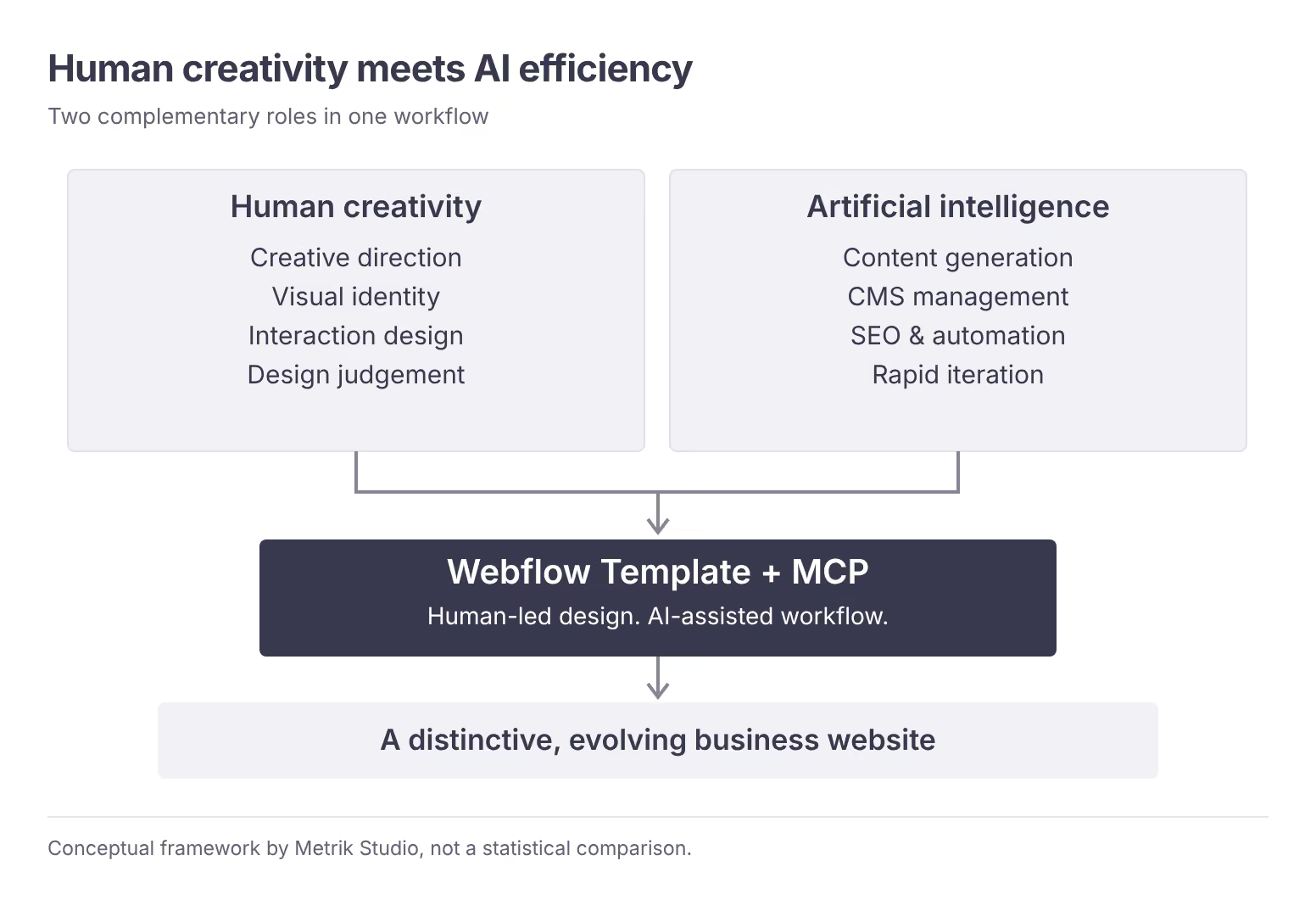
You get a distinctive visual foundation, a structured CMS-powered website and an AI-assisted workflow from the very beginning.
The future of web design is human creativity powered by AI
I do not believe the future of web design is a competition between humans and artificial intelligence.
I believe the most interesting opportunities will come from combining the two.
AI can accelerate development, simplify maintenance, generate ideas and eliminate repetitive tasks. Human creativity can give those capabilities direction, personality and purpose.
As digital content becomes easier to produce, businesses will need to think more carefully about what makes them different, what makes their brand credible and why their audience should remember them.
AI makes websites easier to create. Human creativity gives them a reason to stand out.
The future is not necessarily about building more websites. It is about building better ones.
Frequently asked questions
What is human-centred web design?
Human-centred web design starts with the needs, abilities and goals of the people using a website. It combines usability, accessibility, clear information and thoughtful visual design to create a meaningful experience.
Can AI replace a professional web designer?
AI can support design, content creation and development, but it does not automatically understand a brand, its audience or its business goals. Human creative direction, testing and judgement remain important.
Why start with a professionally designed Webflow template?
A good template provides an established visual identity, reusable layouts and a structured CMS. AI can help adapt that foundation to your business, rather than requiring you to build every element from scratch.
What is Webflow MCP?
Webflow uses the Model Context Protocol (MCP) to connect supported AI assistants to a website project. Depending on permissions and available capabilities, an assistant can help manage content, update CMS items and refine parts of the design. Changes should be reviewed before publication.
References & Sources
- Doshi, A. R. & Hauser, O. P. (2024). Generative AI enhances individual creativity but reduces the collective diversity of novel content. Science Advances.
- Wadinambiarachchi, S. et al. (2024). The Effects of Generative AI on Design Fixation and Divergent Thinking. ACM CHI.
- Nina Schick (2023). Prediction about the share of AI-generated online content. Historical prediction, not a confirmed outcome.
- Europol. Facing Reality? Law Enforcement and the Challenge of Deepfakes. Report on synthetic content and its revision.
- Pew Research Center (2026). How much of the internet is written with AI?.
- Graphite (2026). AI Now Writes as Many Online Articles as Humans Do.
- Stanford Web Credibility Project. Research on website credibility.
- Fogg, B. J. et al. (2003). How do users evaluate the credibility of Web sites? A study with over 2,500 participants.
- Webflow. Webflow MCP. Official information about AI integration.
- Don Norman. People-Centered (Not Tech-Driven) Design.
- Jakob Nielsen (2026). Design Changing from Artifact-Production to Intent-Shaping.